Websites
Landing page vs website: which does your startup need?
A one-page site is not a smaller website. It is a different tool. Here is when each one is right.
By Nabeel Mustafa··Updated ·2 min read

Landing page vs website: this comes up on almost every first call. Someone has a product and a budget, and they are not sure whether they need a landing page or a full site. The answer is not about budget, even though it feels like it is. It is about what the visitor has to do.
A landing page has one job
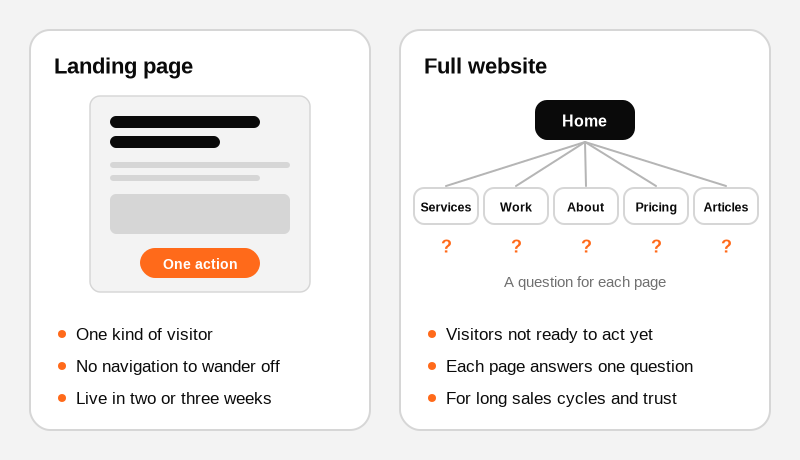
A landing page exists to get one action from one kind of visitor. Sign up, book a demo, join a waitlist, buy the thing. Everything on the page pushes toward that action. There is no navigation to wander off into, because wandering is the enemy.
This makes landing pages excellent for launches, campaigns, early stage products, and anything you want to test before you commit to building more. You can have one live in two or three weeks and learn from real traffic.
A full website answers questions
A full site exists for visitors who are not ready to act yet. They want to understand what you do, see the work, read how you think, check who is behind it, and come back later. Services, work, about, pricing, articles. Each page answers a question a different visitor has at a different time.
If your sales cycle is long, if people compare you with others, or if trust is the main barrier, you need the full site. A landing page alone will convert the people who were already convinced and lose the rest.
The signs you have outgrown a landing page
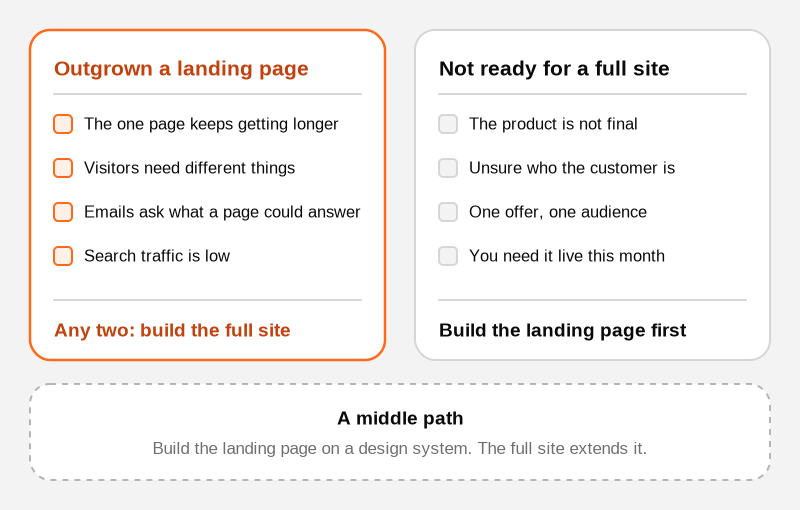
You keep adding sections to the one page and it is getting long. Different visitors need different things and you are trying to serve all of them above the fold. People email you questions that a page could answer. Search traffic is low because there is nothing to rank. Any two of these and it is time.
The signs you do not need a full site yet
The product is not final. You are not sure who the customer is. You have one offer and one audience. You need something live this month. In that case build the landing page, learn from it, and let the full site grow out of what you learn. Many of the best sites I have built started as a single page that earned the right to expand.
Build the page that matches the decision your visitor is making, not the one that matches your ambition.
Landing page vs website: a practical middle path
Start with a landing page built on a proper design system, so that every component can be reused. When the time comes, the full site is an extension, not a rebuild. This is how I scope most early stage projects, and it keeps the first step small without wasting the money spent on it.
If you are unsure which you need, describe the product and the visitor in my contact form and I will tell you plainly. Sometimes the answer is the smaller one.
Frequently asked questions
Is a landing page enough for a startup?
Often, yes, at the start. If you have one product, one audience and one action you want visitors to take, a single focused page does the job and is faster to test. You outgrow it when visitors need answers a single page cannot hold.
How much does a landing page cost compared with a full website?
A custom landing page usually costs a fraction of a full site, because it has one layout and one goal. The price rises with each new page type, integration and piece of content. A full site also takes longer to plan and review.
Can a landing page rank on Google?
It can rank for a narrow set of searches, usually your brand name and one main phrase. A full site with several pages and articles can rank for many more searches, which is one reason companies add pages once the product and message are proven.
Related guides



Next article
How to add AI features to a website in 6 weeks
The order I build in, the guardrails I set on day one, and the questions I ask before picking a model.
Read