AI Products
AI MVP development cost in 2026: a real breakdown
Price ranges by scope, what pushes the number up, what the product costs to run each month, and where you can cut without hurting the launch.
By Nabeel Mustafa··Updated ·6 min read

The honest AI MVP development cost in 2026 ranges from about $25k for a focused product on one model to $150k or more for a multi-model generative platform. The model calls are rarely the expensive part of the build. The cost is in everything around the model: the interface, accounts, billing, limits, evals and the paths for when the answer is wrong.
Below are the ranges I use, the assumptions behind them, what the product costs to run each month, and how to cut scope without shipping something fragile.
AI MVP development cost by scope
These ranges are my own working numbers for a senior freelancer or small studio in the US or UK. They assume a production MVP that real customers pay for, not a demo. They do not include your own time, marketing or legal work.
A focused product on one model: about $25k to $45k
One core flow, for example "paste a document, get a structured summary" or "upload a product photo, get a listing". One model provider, streaming output, accounts, a simple subscription or credit plan, usage limits, basic moderation and a small admin view. Typical timeline: 8 to 12 weeks.
A workflow tool: about $45k to $90k
Several steps chained together, saved projects, file uploads, team accounts, integrations with tools the customer already uses, and review steps where a person approves the output. Evals become more important here, because a change in one step can break the next. Typical timeline: 12 to 16 weeks.
A multi-model generative product: about $80k to $150k and up
Image, video, 3D or audio generation, often with more than one model per job. Long-running jobs with queues and webhooks, large files and storage, credits that are reserved and refunded, heavier moderation and a real admin area. Costs grow with every model and media type you add.
For reference, my own AI Product engagements usually run 12 to 16 weeks, including a week of evals and strategy at the start, auth, billing, guardrails and admin tooling. The price is fixed after a one week discovery, so the range narrows to one number before the build starts.
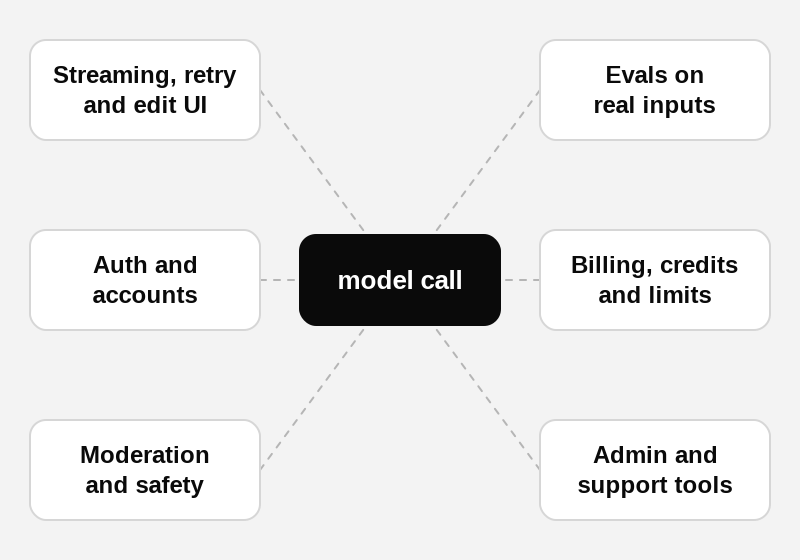
What drives the cost of building an AI MVP?
Two AI MVPs with the same idea can differ in price by three times. These are the levers that move it:
- UX for uncertain output. Streaming, edit and retry controls, history, and clear states for slow, failed or flagged answers. This is most of the interface work, and it is what makes the product feel trustworthy.
- Evals. A test set of real inputs with expected outputs, run on every prompt or model change. It costs a few days up front and saves weeks of guessing later.
- Model choice. One text model behind a single API is cheap to integrate. Several media models, each with its own input format, queue and failure modes, are not.
- Auth, billing and limits. Sign-in, plans, credits or metered usage, and per user limits. Billing has edge cases (refunds, failed payments, upgrades) that take real time to get right.
- Moderation and safety. Prompt checks, output checks, reporting, and a way to suspend accounts. More if users can share outputs publicly.
- Admin and support tools. Seeing what a user did, refunding credits, replaying a failed job. You need this from day one, not month three.
- Data rules. Customer data in prompts, regional storage, retention limits and provider terms all add design and review work.
How much does an AI app cost to run each month?
Unlike most software, an AI product has a real cost every time someone uses it. I plan the running cost before the build, because it decides the pricing model.
- Inference per request. Text models bill per token. Image and video models bill per output or per second of GPU time. Prices vary widely between models, so check the current price list for each one you consider.
- Storage and bandwidth. Generated media adds up fast. Provider output URLs are usually temporary, so you pay to keep files in your own storage and to serve them.
- Hosting, database and monitoring. Usually modest at MVP scale, often well below the inference bill.
- Third party services. Email, auth, payments fees, error tracking and moderation APIs.
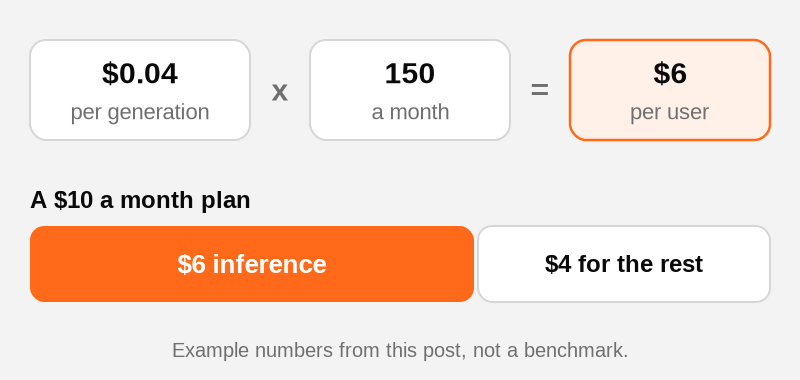
To estimate inference, use simple math with your own numbers. If one generation costs you $0.04 and an active user makes 150 a month, that user costs $6 a month in inference alone. If your plan is $10 a month, you have $4 left for everything else. Those numbers are an example, not a benchmark, but the math is the same for every product.
On GPU versus API: for an MVP I almost always start with hosted APIs. You pay per use, nothing when the product is quiet, and you can swap models in an afternoon. Dedicated GPUs bill by the hour whether they are busy or not, and they need someone to run them. Move to your own hardware when usage is high and steady, and only after the API bill tells you it is worth it.
How to cut the cost of an AI MVP without cutting quality
Cut scope, not foundations. These cuts are safe for most first versions:
- Ship one core flow, not three. Pick the one people would pay for on its own.
- Use one model provider at launch and design so it can be swapped later.
- Start with simple credit packs or one subscription tier instead of complex metered pricing.
- Use a hosted auth and billing provider instead of building your own.
- Launch to a waitlist group first, so moderation and support load start small.
- Skip team accounts and integrations until customers ask for them.
Cuts I do not recommend: skipping evals, skipping usage limits, and skipping an admin view. Each one is cheap to build early and expensive to add after the first incident. The five questions I ask before any AI build are a good way to decide what is truly core.
A clear brief is the other big saver. If you can describe the users, the core flow, and what a good output looks like, the quote gets tighter and the build gets faster. The Brief builder in my Lab helps you write one in a few minutes.
Freelancer vs agency vs in-house: who should build your AI MVP?
- A senior freelancer is usually the leanest option for a focused MVP. You get one person who owns design and code, and fewer handoffs. The risk is capacity: check that they can cover the whole stack, including billing and infrastructure.
- An agency brings more people and can run several streams in parallel. It costs more per week, and you should ask who will actually do the work.
- An in-house team makes sense once the product has traction and needs constant iteration. Hiring takes months, so it is rarely the fastest way to a first version.
Whoever you choose, ask for the same things: a fixed price after discovery, a staging link early, an eval set you own, and full handover of code, prompts and data at the end.
Wrapping up
Plan for roughly $25k to $45k for a focused AI MVP, more for workflows and multi-model products, plus a monthly running cost you can estimate before you build. Spend the budget on the things around the model, because that is what customers judge. If you want a fixed quote for your idea, see how I build AI products.
Frequently asked questions
Can I build an AI MVP for under $10,000?
You can build a prototype for that, especially with no-code tools or a template, and it is a good way to test demand. It will usually skip billing, limits, evals, moderation and an admin area. That is fine for a test with a small group, but plan a second budget before you open it to the public.
How long does it take to build an AI MVP?
A focused AI MVP with one core flow, accounts and billing usually takes 8 to 12 weeks with an experienced builder. A product with several models, file handling and team features is more like 12 to 20 weeks. Most delays come from unclear scope and slow decisions, not from the model work itself.
Is it cheaper to use an API or host my own model?
For an MVP, an API is almost always cheaper and faster. You pay per request and nothing when nobody uses the product. Your own GPUs cost money every hour they run, used or not, and need engineering time to operate. Self-hosting starts to make sense when volume is high and steady, or when data rules require it.
Do I need a technical cofounder to build an AI MVP?
Not to build the first version. A freelancer or studio can ship it and hand over the code, prompts and evals. You do need someone who owns the product after launch, because AI products need ongoing tuning as users find new cases. That can be a hire, a retainer or a cofounder later.
Related guides



Next article
GSAP text animation: 6 SplitText effects with code
Line reveals, word staggers, a char wave, scramble, scroll scrub and a hover roll. Each one is short, works in React and stays readable for screen readers.
Read